
How to prepare for your trip to Portugal
The language you will hear, the phrases to learn first, money, plugs, emergency numbers and a few local habits, and a way to plan the trip and keep your phrases offline.
Try it free for 14 days.
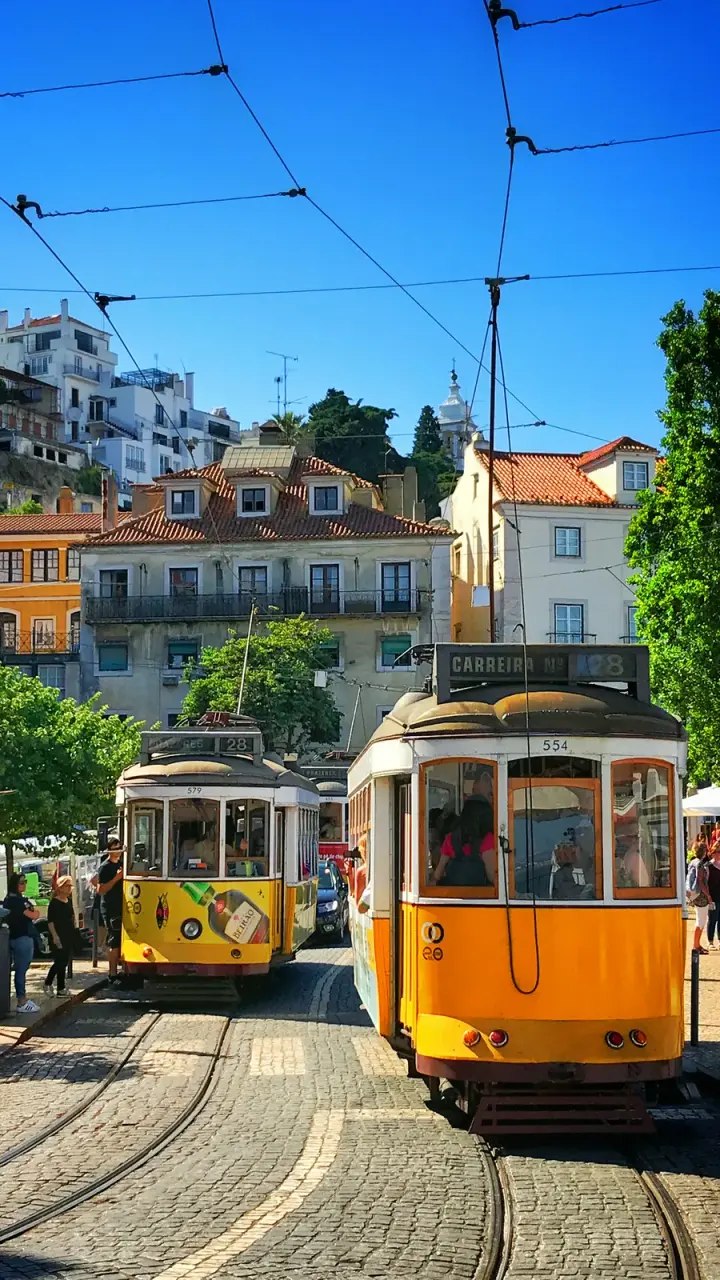
Photo credit
Photo of trams in Lisbon by Victor Malyushev (opens in a new tab) on Unsplash, used under the Unsplash License (opens in a new tab).
What you will hear in Portugal.
Portuguese is spoken everywhere in Portugal, including Madeira and the Azores. In Lisbon, Porto and the Algarve many people speak some English, and the effort in Portuguese is welcomed. Portuguese in Portugal sounds different from the Portuguese of Brazil.
Small habits are worth knowing: a small espresso is a bica in Lisbon and often a cimbalino in Porto, and the islands have words of their own.
Lisbon, Porto, the Algarve, Sintra, Madeira and the Azores are all in Portugal.
Phrases for your first day.
They come from the first lessons. In the app each has audio and a note on when to use it, and you can save it to your phrasebook.
Bom dia, senhora.
Good morning, madam.
Desculpe, senhora…
Excuse me, madam…
Quanto custa isto?
How much does this cost?
Onde fica a estação?
Where is the station?
Pode repetir, por favor?
Could you repeat that, please?
A conta, por favor.
The bill, please.
Queria um café, por favor.
I'd like a coffee, please.
Não percebo.
I don't understand.
Portugal at a glance.
These are usually right but not always. For anything that matters, check the official advice before you go.
- Euro (€)
- +351
- On the right
- Type C, F · 230 V
- 112
Entry rules, health advice and safety change, so they are not on this page. The UK Foreign, Commonwealth & Development Office keeps them up to date for UK travellers: UK government travel advice for Portugal (opens in a new tab).
Habits worth knowing before you arrive.
Habits, not rules: places and people vary, so each note says where it applies.
In mid to late June, Lisbon and Porto hold street festivals for Saint Anthony and Saint John, with grilled sardines and crowded evenings. Book rooms early if you want to be there.
A small plate of bread, olives and cheese, the couvert, is often brought to the table. It is usually charged if you eat it, so say no thank you if you do not want it.
Many restaurants serve a dish of the day, the prato do dia, at lunch. It is often quicker and cheaper than choosing from the main menu.
The word for a small strong coffee changes by region: in Lisbon it is often a bica, in Porto a cimbalino, and elsewhere simply um café.
Portuguese is not Spanish, and many people appreciate a try at bom dia, por favor and obrigado (obrigada if you are a woman) before the conversation moves to English.
Plan the trip to Portugal in one place.
Put it on days
Add Portugal to a trip, then put places on days with a time and a note. Directions open in your maps app.
Save the videos
Paste the TikTok, Instagram or YouTube link that gave you the idea and attach it to the stop it belongs to.
Take your phrases offline
Download the travel guide on Wi-Fi. The phrasebook, packs, notes and audio work with no signal.
Share the plan
Send a link to the people you are going with. They can read it without an account, and you can invite them to edit.
About a trip to Portugal.
Do I need Portuguese in Portugal?
Many people in Lisbon, Porto and the Algarve speak some English. Portuguese helps in smaller towns and away from the coast.
Is Brazilian Portuguese the same?
No. Pronunciation, some everyday words and the "you" forms differ. For Portugal, learn European Portuguese.
Does it cover Madeira and the Azores?
Yes. Each has a note on places, food and the local words.
Other trip guides
Be ready to speak when you land in Portugal.
Create a free account, add the trip, and start with the phrases for your first hour.
Try it free for 14 days.