
How to prepare for your trip to Spain
The language you will hear, the phrases to learn first, money, plugs, emergency numbers and a few local habits, and a way to plan the trip and keep your phrases offline.
Try it free for 14 days.
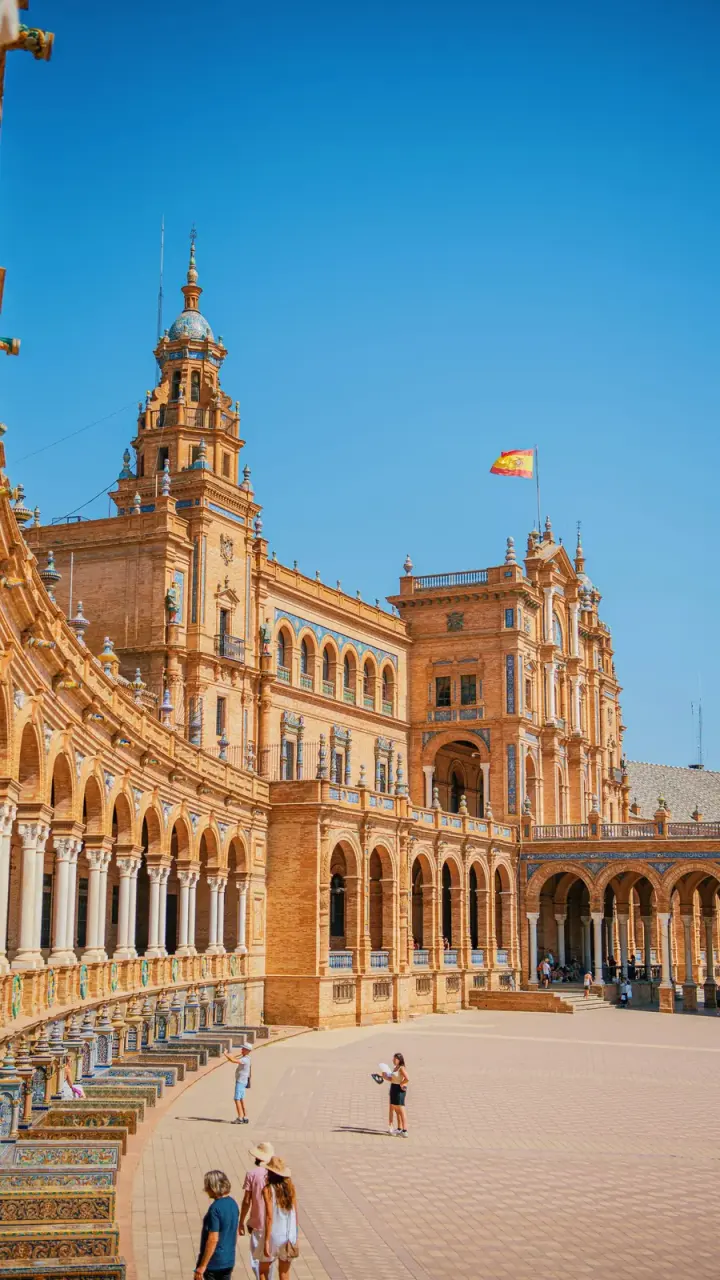
Photo credit
Photo of Plaza de España, Seville by Tânia Mousinho (opens in a new tab) on Unsplash, used under the Unsplash License (opens in a new tab).
What you will hear in Spain.
Spanish is spoken across Spain. Catalan, Basque, Galician and Valencian are co-official in their regions, so you will see them on signs and menus in Catalonia, the Balearic Islands, the Valencian Community, the Basque Country and Galicia. Spanish works everywhere.
In the Canary and Balearic Islands and on the southern coast, many hotels and restaurants are used to English-speaking visitors. Away from the resorts you will use Spanish more. In Spain people usually say "vosotros" to a group of friends, where Latin America says "ustedes".
Madrid, Barcelona, Seville, Valencia, Mallorca, Ibiza, Tenerife, Lanzarote, Gran Canaria and the Costa del Sol are all in Spain, so this guide covers them.
Phrases for your first day.
They come from the first lessons. In the app each has audio and a note on when to use it, and you can save it to your phrasebook.
Hola, buenos días.
Hello, good morning.
Muchas gracias.
Thank you very much.
Disculpe, ¿está libre?
Excuse me, is this free?
¿Cuánto cuesta esto?
How much is this?
¿Habla inglés?
Do you speak English?
¿Puede repetir, por favor?
Could you repeat that, please?
La cuenta, por favor.
The bill, please.
Quisiera un café con leche, por favor.
I'd like a white coffee, please.
Spain at a glance.
These are usually right but not always. For anything that matters, check the official advice before you go.
- Euro (€)
- +34
- On the right
- Type C, F · 230 V
- 112, 061, 091
Entry rules, health advice and safety change, so they are not on this page. The UK Foreign, Commonwealth & Development Office keeps them up to date for UK travellers: UK government travel advice for Spain (opens in a new tab).
Habits worth knowing before you arrive.
Habits, not rules: places and people vary, so each note says where it applies.
In July and August it can be very hot in much of the interior and the south, and many people rest in the middle of the day. Plan outdoor sightseeing for the morning or the evening.
Meals often start later than in the UK, with lunch commonly after two and dinner after nine. Many kitchens close in between, so tapas or pinchos at a bar can fill the gap.
Many restaurants offer a menú del día at lunch on weekdays: a set meal with a starter, a main and a drink, often cheaper than ordering the same dishes separately. It is usually written on a board outside.
Spain has several official languages, such as Catalan, Galician and Basque, alongside Spanish. Signs may use the local language first, and a few words of it are often welcomed.
Plan the trip to Spain in one place.
Put it on days
Add Spain to a trip, then put places on days with a time and a note. Directions open in your maps app.
Save the videos
Paste the TikTok, Instagram or YouTube link that gave you the idea and attach it to the stop it belongs to.
Take your phrases offline
Download the travel guide on Wi-Fi. The phrasebook, packs, notes and audio work with no signal.
Share the plan
Send a link to the people you are going with. They can read it without an account, and you can invite them to edit.
About a trip to Spain.
Do I need Spanish in Spain?
Many people in resorts and big cities speak some English. Spanish helps in smaller places, in bars and markets, and in the regions away from the coast.
Is Tenerife or Lanzarote in Spain?
Yes. The Canary Islands are part of Spain, and Spanish is the language there, with its own local accent and words.
Which Spanish should I learn for Spain?
Spanish (Spain). It teaches "vosotros", the words you will see on menus, and the regions from Madrid to the Canaries.
Other trip guides
Be ready to speak when you land in Spain.
Create a free account, add the trip, and start with the phrases for your first hour.
Try it free for 14 days.